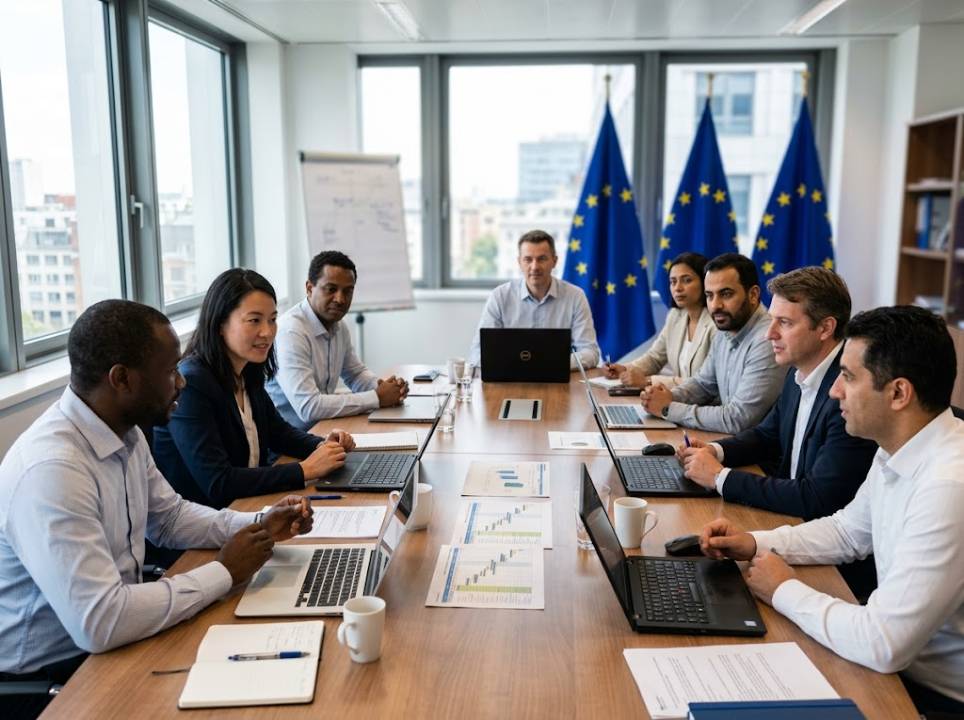
Anyone who has coordinated a European research consortium or an Erasmus+ partnership knows the feeling. There are partners in Lisbon, Kraków, Tartu and Bologna. Reports are due in English, dissemination material must reach local audiences in their own languages, and the final conference needs interpreting. Somewhere between the kick-off meeting and the final report, translation becomes a project of its own.
Treating it as an afterthought is one of the most common reasons multilingual projects run late or over budget.
Why translation gets messy in consortia
In a typical consortium, each partner handles translation for its own country. One university uses a student, another hires a freelancer, a third relies on a colleague who "speaks good English". The result is a patchwork of styles, inconsistent terminology and unpredictable deadlines.
Key project terms, such as the names of work packages, outputs and methods, end up translated in different ways. A policy brief in Portuguese may describe a concept differently from the Polish version of the same brief, which confuses stakeholders and weakens the project's message.
Plan translation at proposal stage
The best time to think about languages is before the grant is signed. Budget lines for translation, proofreading and interpreting should be realistic and based on estimated word counts. Many proposals underestimate these costs or hide them in general dissemination budgets, which leads to painful compromises later.
It also helps to agree early on which documents need full professional translation, which can use lighter review, and which will remain in English only.
Centralise the workflow
Instead of letting every partner manage translations separately, many coordinators now use a shared translation workflow management system. Source texts are uploaded once, assigned to translators for each language, reviewed by a partner who knows the local context and tracked on a single dashboard.
This gives the coordinator a clear view of progress, costs and bottlenecks. It also creates an audit trail, which is useful when funding bodies ask how resources were used.
Shared terminology from day one
A project glossary is one of the cheapest and most effective tools available. It lists the key terms of the project in English with approved equivalents in each partner language. Translators and partners consult it for every deliverable.
Modern editors display glossary terms automatically while the translator works. When comparing platforms to find the best cat tool for a consortium, it is worth checking how easily external partners can access the glossary and suggest new terms, since researchers often coin new concepts during the project.
Including new languages and communities
Since 2022, many European projects in education, health and social inclusion have started working directly with Ukrainian communities. Surveys, consent forms, workshop materials and reports now often need Ukrainian versions, and interviews conducted in Ukrainian must be rendered accurately for analysis.
For research purposes, an experienced ukrainian translator english who understands both the subject and the ethical requirements of research is essential. Participants' words should be translated faithfully, without smoothing or interpretation that could bias the results.
Interpreting at events
Final conferences, multiplier events and stakeholder workshops often involve interpreting. Remote simultaneous interpreting platforms have made this more affordable, but good sound quality and experienced interpreters are still non-negotiable. Sending slides and speaker notes to interpreters in advance makes a huge difference.
Quality checks and sign-off
Every translated deliverable should pass through at least one review by a native speaker familiar with the subject. Ideally, this is a partner organisation in that country, since they know the audience and can judge whether the text will resonate locally.
Clear sign-off rules avoid endless loops of comments. Agree in advance who approves each language version and how many review rounds are included.
Accessibility and plain language
Dissemination materials often target citizens, teachers or patients rather than specialists. Plain language versions, easy-to-read summaries and accessible formats reach far more people than dense academic prose. Translators should receive these guidelines along with the source text, so the tone stays accessible in every language.
After the project ends
Translation memories, glossaries and translated deliverables are valuable assets. When the project closes, they should be archived in a standard format and shared with all partners. Follow-up projects, spin-off initiatives and national adaptations can then build on this work instead of starting again from zero, which saves money and keeps the language of the project consistent for years.
Practical steps for coordinators
- Estimate translation volumes and costs in the proposal.
- Create a project glossary before the first deliverable.
- Use one shared platform instead of scattered email threads.
- Assign a native reviewer from each partner country.
- Keep translation memories and hand them over at project end.
Aligning with funders
The European Commission places strong emphasis on dissemination and exploitation of results across member states. Projects that communicate clearly in several languages show greater impact and make their results genuinely usable across Europe. A well-organised translation process is therefore not only an administrative convenience, but part of delivering on the promise of the grant.